

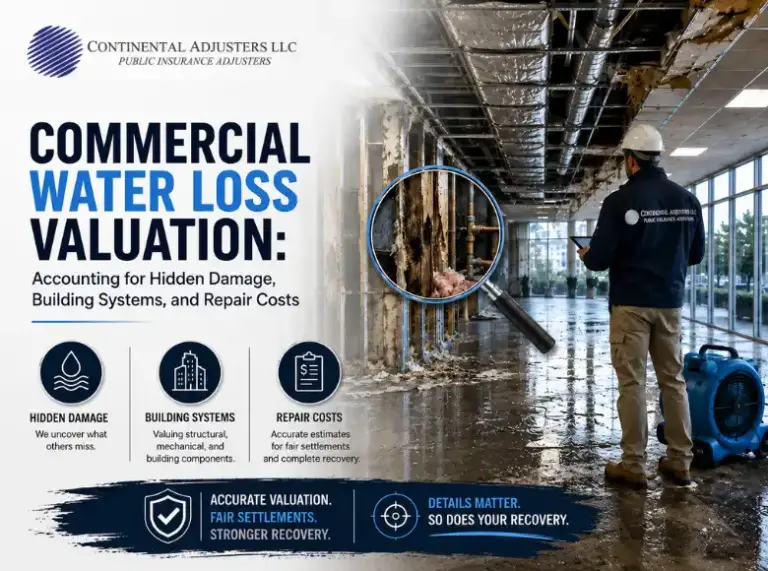
A commercial property can appear to be drying out while significant damage remains inside walls, beneath flooring, above ceilings, or within building systems.
That is why Commercial Water Loss Valuation should not be treated as a simple calculation based on the areas that were visibly wet. A proper commercial water damage assessment starts with understanding what happened, where the water traveled, which components were affected, what must be repaired or replaced, and what documentation supports those conclusions.
The issue is especially relevant because businesses continue to face losses from severe storms, flooding, plumbing failures, and other water-related events.
During the first half of 2026, the U.S. experienced 12 billion-dollar weather and climate disasters, according to Climate Central. Eight were classified as severe-storm events, while flooding and winter weather also contributed to major losses.
For a commercial property owner, the practical lesson is simple: the first visible damage is not necessarily the full loss.
What Commercial Water Loss Valuation Really Covers
A meaningful Commercial Water Loss Valuation considers the complete impact of the loss rather than focusing only on water extraction and cosmetic repairs.
A commercial property may contain electrical equipment, HVAC systems, plumbing, insulation, specialized machinery, inventory, tenant improvements, and expensive interior finishes. The effect of water on each component can be different.
A warehouse affected by a failed sprinkler line will have different valuation considerations than a hotel dealing with a major plumbing failure. A manufacturing facility may have specialized equipment, while an office building may have extensive tenant improvements and electrical infrastructure.
The valuation needs to reflect the actual property, the source of the water, and the path the water took.
The Damage You Cannot Immediately See
Water does not always stay where it first appears.
A pipe failure above a ceiling, for example, can saturate insulation, damage drywall, reach electrical components, and migrate into adjacent areas. Removing the damaged ceiling may solve the visible problem without addressing what is happening behind it.
That is where a detailed commercial water damage assessment becomes important. The objective is to identify the affected areas and connect the documented conditions to the work required for restoration.
For complex commercial losses, thorough damage assessment and documentation can also help establish the scope of the claim before damaged materials are removed or restoration work changes the condition of the property.
Hidden Damage Can Change the Entire Claim
The first inspection is not always the final picture.
Moisture can remain inside wall assemblies, beneath flooring, or around mechanical and electrical components. Flooring may separate or deform. Metal components can corrode. Equipment may require professional testing before it can safely return to service.
These conditions can create water intrusion property damage that is easy to overlook during an initial walkthrough.
Documenting water intrusion property damage early can help establish the full extent of affected materials and building components before restoration work removes important evidence.
The longer a loss remains undocumented, the more difficult it can become to establish what was originally affected. Once damaged materials are removed and repairs begin, important evidence can disappear.
Building Systems Need Their Own Evaluation
Commercial buildings operate as interconnected systems. Water reaching one component can create consequences somewhere else.
Imagine an office building where a supply line breaks above a mechanical room. The ceiling and flooring may show obvious damage, but water could also reach electrical distribution equipment, HVAC controls, communications equipment, or other building systems.
The question is not simply, “What needs to be dried?”
It is also, “What was exposed, what condition is it in, and what does it take to safely restore it?”
Not every component automatically requires replacement. At the same time, a component should not automatically be considered repairable simply because it appears functional. The appropriate treatment may depend on the type of exposure, condition, safety requirements, manufacturer recommendations, and professional findings.
That distinction directly affects water damage repair costs.
Detailed documentation can also help establish water damage repair costs when multiple building components, systems, or specialized equipment require repair or replacement.
When the cause, condition, or appropriate repair of a building component becomes disputed, expert witness services may provide technical analysis to help explain the damage, repair requirements, or valuation issues involved in the claim.
What 2026 U.S. Flooding Can Teach Commercial Owners
Recent flooding events show why commercial water losses require careful documentation. In July 2026, severe storms and flash flooding affected parts of Iowa, with SBA assistance made available for eligible businesses facing damage to real estate, equipment, machinery, and inventory. Similar storm and flooding losses affected businesses in New York earlier in the year.
Consider a distribution facility where flooding damages flooring, drywall, insulation, and inventory. What initially appears to be a simple cleanup can become more complex if moisture reaches wall cavities, electrical components, HVAC equipment, or additional inventory. Photographs, repair estimates, inventory records, and other documentation can help connect the event to the full scope of damage and the work required for restoration.
This is an illustrative example based on common commercial-loss conditions and is not presented as a Continental Adjusters client claim.
Why Water Loss Severity Deserves Attention
Commercial water losses are not necessarily minor simply because they are not classified as catastrophic events.
Verisk reported in January 2026 that non-catastrophe commercial property water severity had increased 41% over the five-year period from Q3 2020 through Q2 2025. The report also found commercial property water severity was 5% higher year over year during the latest period analyzed.
For property owners, the takeaway is important. Even a localized plumbing failure can involve expensive building components, specialized equipment, reconstruction, and operational disruption.
That is why a detailed commercial property loss valuation should be based on documented conditions rather than a quick estimate of visible repairs.
Where a Public Adjuster Can Help
Major commercial claims can become difficult to manage while a business is also dealing with employees, tenants, contractors, damaged inventory, financial records, and an insurance carrier.
A public adjuster can help organize the claim from the policyholder’s side, including damage documentation, estimating, loss analysis, policy review, and negotiations.
Continental Adjusters works with policyholders on complex commercial property losses and provides public adjusting services designed to help evaluate and present large insurance claims. For a significant water loss, professional representation can help bring the different pieces of the claim into one coordinated process.
The goal should be to develop a well-supported claim that accurately reflects the documented loss and the policyholder’s recovery needs.
Financial Losses Can Extend Beyond the Building
A commercial water loss can create financial consequences beyond physical repairs. If operations are interrupted, a business may experience lost income, continuing expenses, or additional costs associated with maintaining or restoring operations.
These financial impacts may require analysis separate from the physical property damage. Forensic Accounting can help evaluate financial records and quantify business interruption-related losses when applicable to the policy and circumstances of the claim.
For a business dealing with both physical property damage and operational disruption, considering these financial effects as part of the overall claim can provide a more complete picture of the loss.
When Commercial Water Loss Valuation Becomes Disputed
Even when damage has been thoroughly documented, disagreements can arise over the scope of repairs, replacement costs, or the overall value of a commercial property loss.
That is where Umpire & Appraisal Services may become relevant when an insurance policy provides for an appraisal process to address a disagreement over the value of the loss.
For example, the policyholder and insurer may agree that covered damage occurred but disagree about the appropriate cost of restoring a building system, replacing affected property, or determining the overall amount of the loss. An appraisal process can provide a mechanism for addressing valuation disputes when the policy’s requirements are met.
Building a Stronger Commercial Water Loss Valuation
A strong Commercial Water Loss Valuation ultimately connects four questions: what happened, what was damaged, what needs to be done, and what evidence supports the work.
That means documenting the cause and pathway of the water, identifying affected areas, evaluating building systems, accounting for damaged contents, and supporting repair and reconstruction requirements with detailed estimates.
A comprehensive commercial property loss valuation should account for the documented physical damage, repair requirements, affected building systems, and other covered components of the loss.
When the loss is complex, financial analysis may be necessary to document business interruption impacts, while technical disputes may require Expert Witness Services. If the value of the property loss becomes disputed, Umpire & Appraisal Services may also be relevant when provided for under the policy.
When the loss is complex, getting professional guidance early can make the process easier to manage and help prevent important damage or documentation from being overlooked.
If your commercial property has experienced flooding, water intrusion, plumbing failure, or another significant loss, Continental Adjusters can help evaluate the damage, document the claim, develop the loss presentation, and advocate for your interests throughout the recovery process.
Frequently Asked Questions
What is Commercial Water Loss Valuation?
It is the process of identifying, documenting, and evaluating the financial impact of water damage to a commercial property, including building components, systems, equipment, contents, and necessary repairs.
Can hidden water damage affect an insurance claim?
Yes. Moisture concealed inside walls, flooring, ceilings, insulation, or building systems can affect the overall scope of restoration and may require additional investigation.
How are Water Damage Repair Costs supported?
Repair costs can be supported through detailed estimates, photographs, measurements, contractor documentation, invoices, equipment information, and other records showing the work required.
Should a business hire a public adjuster after major water damage?
For a complex loss involving extensive property damage, equipment, inventory, business interruption, or disputed valuation, a public adjuster may provide valuable claim-management and policyholder representation.
Can business interruption be part of a commercial water loss?
Potentially. If the policy provides applicable business interruption coverage, lost income and additional expenses may need to be calculated and supported through financial records. Forensic Accounting can help quantify and document these financial impacts.
What happens if the insurer and policyholder disagree about the value of the loss?
Depending on the policy, an Umpire & Appraisal Services process may be available to address disagreements over the value of the property loss.
A Strong Recovery Starts with a Well-Built Claim
A commercial property loss can involve much more than the damage you can see. Hidden damage, repairs, equipment, inventory, interrupted operations, and other financial impacts may all become part of the claim.
Working through a complex claim without a clear strategy can make it harder to document the full scope of your loss. Continental Adjusters LLC helps commercial property owners assess damage, document losses, review policy coverage, calculate claim values, and navigate negotiations with insurers.
If you are dealing with a significant or disputed commercial property loss, an early review can help you understand what needs to be documented and what steps to take next. Contact Continental Adjusters LLC for a complimentary claim review before finalizing your claim or accepting a settlement.