

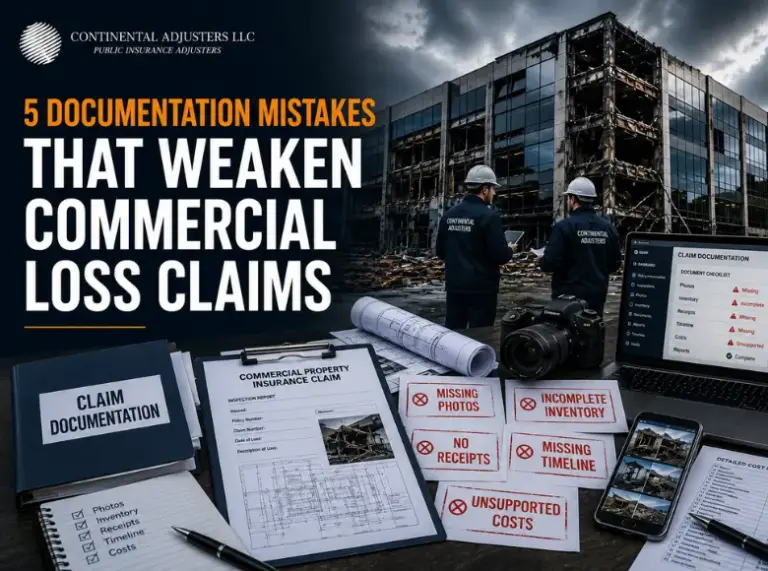
Your commercial property has sustained a significant loss, and the outcome of your insurance claim may depend heavily on the quality of your documentation. Thorough, accurate records can make the difference between a full recovery and a settlement that falls short. This article examines five common documentation mistakes that can weaken large commercial loss claims and explains how to avoid them.
Why Commercial Claim Documentation Decides Large Loss Outcomes
A large commercial claim is not just a form to file; it’s a case that must be supported by clear, credible evidence. Insurers evaluate payment based on the documentation presented. Incomplete or insufficient evidence can create opportunities to question the cause, scope, or value of the loss.
Every commercial insurance policy establishes requirements for substantiating a loss. Most require a sworn proof of loss, records supporting the amount claimed, and cooperation throughout the insurer’s review. When documentation is incomplete, payment may be delayed, reduced, or denied. Comprehensive records help support the policyholder’s position throughout the claims process.
Five Documentation Mistakes That Weaken Large Commercial Loss Claims
1. Waiting Too Long to Document the Damage
Evidence fades fast after a loss. Water dries, debris gets cleared, and crews start repairs before anyone captures the full picture. Once that happens, you lose claim evidence that can’t be recreated.
Document the property before cleanup or repairs begin whenever it is safe to do so. Photograph and record video of every affected area, including ceilings, mechanical systems, and concealed spaces. Preserve damaged materials when appropriate and safe, as physical evidence may provide important support beyond photographs alone.
2. Photographing Damage Without Recording Cause and Scope
Photographs can establish that damage exists, but they may not demonstrate what caused it or the full extent of its impact. When the cause of loss is unclear, questions may arise regarding coverage or the potential application of policy exclusions.
Pair photographs and videos with detailed notes identifying the date, location, and circumstances surrounding the damage. For complex losses, engineers or other qualified experts may help establish causation. Clear evidence regarding the cause of loss can strengthen the claim and help address disputes involving coverage or exclusions.
3. Leaving Business Interruption Losses Undocumented
Physical property damage may represent only one component of a commercial loss. When operations are interrupted, the resulting loss of income and additional expenses may also be covered under the policy. Focusing solely on building damage can leave significant financial losses insufficiently documented.
Track all lost sales, ongoing expenses, payroll, and extra costs associated with keeping the business running. Pull profit and loss statements, tax returns, and sales records that show your normal earnings. Forensic accounting turns those records into a business interruption claim to present to your carrier.
4. Trusting the Insurer’s Adjuster to Capture the Full Scope
The insurer’s adjuster represents the insurer’s interests. An inspection may not identify every area of damage, particularly when conditions are complex or damage is concealed. Relying solely on the insurer’s documentation may leave portions of the loss unsupported.
Maintain an independent record of the loss, including your own photographs, estimates, repair proposals, invoices, and notes. A public adjuster represents the policyholder, independently documents the loss, and evaluates the damage in relation to the applicable policy.
5. Skipping Pre-Loss Documentation
A commercial property claim often requires a comparison between conditions before and after the loss. Without clear pre-loss documentation, questions may arise regarding whether damage existed previously or whether claimed values are adequately supported. Missing baseline records can therefore weaken an otherwise valid claim.
Maintain current records before a loss occurs, including updated inventories, recent appraisals, maintenance logs, and photographs showing the property’s condition. These records provide an important baseline for valuation and can help reduce disputes during the claims process.
Documentation Mistakes at a Glance
| Mistake | Effect on the Claim | Better Practice |
| Delayed documentation | Lost evidence and weaker proof | Record the scene before cleanup |
| No proof of cause | Denials and coverage disputes | Document cause with notes and experts |
| Ignoring income loss | Underpaid business interruption | Track revenue and expenses from day one |
| Relying on the carrier | Missed damage and low estimates | Keep an independent record |
| No pre-loss records | Valuation disputes | Maintain inventories and appraisals |
Case Study: A Tornado Claim That Recovered Millions in Missed Value
An office park sustained extensive tornado damage, and the insurer initially offered $6.7 million to settle the claim. The property owner engaged Continental Adjusters LLC approximately ten months after the event, after the strongest initial documentation opportunity had passed.
The delay made the claim more challenging because evidence had aged and repairs were already underway. The Continental Adjusters team reconstructed the loss record, evaluated the full scope of damage in relation to the policy, and supported a more comprehensive valuation of the claim.
The claim ultimately settled for $11.5 million, representing a 72 percent increase over the initial offer. Additional outcomes are available on the Continental Adjusters case studies page. The key takeaway is clear: comprehensive documentation can help support the full value of a claim, and beginning the process early provides a stronger foundation.
How to Build a Documentation Record That Holds Up
Use this checklist after any large commercial loss:
- Photograph and film all damage before cleanup or repairs begin
- Note the date, cause, and location for every image
- Preserve damaged materials and equipment when it is safe to do so
- Collect financial records that show lost income and extra expenses
- Keep copies of every estimate, invoice, and carrier communication
- Store pre-loss inventories, appraisals, and maintenance logs
When a claim becomes complex or valuation is disputed, independent representation can help protect the policyholder’s position. A public adjuster, or when appropriate, a formal appraisal and umpire process, may help resolve valuation differences that delay settlement.
Frequently Asked Questions
What documentation do I need for a large commercial claim?
You need documentation supporting the damage, its cause, and its value. This may include photographs, videos, repair estimates, financial records, inventories, appraisals, and other pre-loss documentation. Generally, larger and more complex losses require a greater level of detail.
Can I still recover if I did not document the damage right away?
Yes, although the process may be more difficult. An experienced team may be able to reconstruct the loss using available evidence and records. However, documenting the loss as early as possible generally provides the strongest support for the claim.
Who has to prove the cause of my loss?
The policyholder is generally responsible for supporting the claim and demonstrating that the loss falls within the policy’s coverage. Engineers and other qualified experts can help establish causation when it is questioned. Clear evidence of cause can help address disputes regarding whether the damage is covered.
How do I document business interruption losses?
Track lost revenue, continuing expenses, and additional costs incurred to maintain operations. Financial statements, tax returns, sales records, and related documentation can support the calculation. Forensic accounting may also be used to quantify and substantiate the business interruption loss.
Should I keep my own records if the insurer already sent an adjuster?
Yes. The insurer’s adjuster represents the insurer, so maintaining your own photographs, estimates, notes, and supporting records provides an independent basis for evaluating and comparing the insurer’s findings.
Protect Your Claim from the Start
A large commercial loss presents significant operational and financial challenges. Comprehensive claim documentation helps protect the value of the recovery and reduces uncertainty regarding the cause, scope, and valuation of the loss.
If you are facing a complex or disputed commercial property claim, an initial consultation can help clarify your options. Continental Adjusters LLC offers a complimentary claim review for commercial property owners. Contact us to discuss your situation and determine the appropriate next steps