

Introduction
Ice storms are among the most disruptive winter weather events in the United States. When freezing rain accumulates on surfaces, it can cause catastrophic damage to buildings, infrastructure, and utilities — with consequences that ripple through communities, businesses, and household finances.
According to the National Weather Service (NWS), freezing rain and ice storms contribute to an average of over $1.3 billion in property losses annually in the U.S. — a figure that ranks winter weather among the costliest natural hazards each year. The Federal Emergency Management Agency (FEMA) also notes that ice storms can disable power to tens of thousands of customers, increase forest damage, and create widespread hazards on roadways.
Understanding what ice storm damage looks like and how to navigate insurance claims is essential for commercial and residential property owners alike.
What Is Ice Storm Damage?
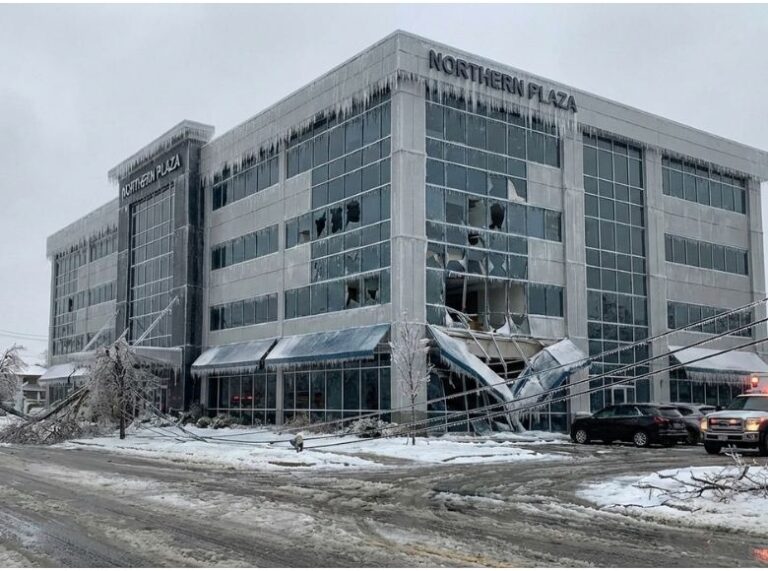
Ice storm damage occurs when supercooled rain freezes on contact with the ground and structures, forming heavy layers of ice. This is distinct from snow, which is lighter and less adhesive.
Because ice adds significant weight to surfaces, it stresses structures in ways that snow rarely does:
- Ice adds approximately 425–500 pounds of additional weight per square foot when just ½ inch accumulates on a surface such as a rooftop or tree limb.
- Heavy accumulations (≥ ½ inch) frequently result in roof collapse, snapped support beams, and broken tree limbs.
- Utility infrastructure — including power lines and poles — is particularly vulnerable, leading to extended power outages.
These effects compound when temperatures fluctuate, allowing melting and refreezing that can infiltrate building envelopes, promote water intrusion, and stress materials over time.
In the aftermath of an ice storm, hidden or secondary damage — such as burst pipes, saturated insulation, and compromised HVAC systems — can emerge long after the storm has passed.
How Much Damage Do Ice Storms Cause?
Ice storms are deceptively destructive because the damage often outpaces visual appearance:
| Ice Accumulation Level | Typical Damage | Severity |
|---|---|---|
| Light (≤ ¼ “) | Slick surfaces, minor limb breakage | Low |
| Moderate (¼ – ½ “) | Sagging utility lines, shingle damage | Moderate |
| Heavy (≥ ½ “) | Roof failure, structural stress | High |
| Severe (≥ 1 “) | Widespread building compromise | Very High |
Real U.S. figures:
- The February 2021 ice storm in the central U.S. caused millions in insured losses, with tens of thousands of power outages across Oklahoma, Arkansas, and Missouri.
- The January 1998 North Carolina ice storm resulted in an estimated $1.5 billion in statewide damage, including tens of thousands of damaged trees and utility interruptions.
These events highlight how rapidly ice accumulation can escalate from nuisance to disaster.
How Ice Storm Damage Insurance Coverage Works
Ice storm coverage is typically part of standard property insurance policies, but what’s covered depends on policy language, endorsements, and exclusions.
Standard Coverage May Include:
| Coverage Type | What it Pays For |
|---|---|
| Structural Damage | Roofs, walls, foundations |
| Contents | Furniture, equipment, inventory |
| Business Interruption | Lost revenue if operations close |
| Debris Removal | Cleanup of ice-related debris |
| Additional Living Expense | Temporary housing costs if displaced |
Important Distinctions
- Ice damming — where melted ice refreezes at roof edges — may not be covered unless it causes sudden and accidental damage such as interior water loss.
- Coverage can be denied if insurance carriers determine damage is due to lack of maintenance rather than a covered storm event.
Understanding your policy’s definitions, limits, and deductibles is essential before filing a claim.
Step-by-Step Ice Storm Insurance Claim Process
Handling an ice storm damage claim efficiently improves your chances of a fair settlement:
- Ensure Safety First
- Secure utilities and avoid hazards like downed power lines.
- Take temporary measures to prevent further damage (e.g., tarping the roof).
- Document All Damage
- Photograph every damaged area from multiple angles.
- Record time, date, and weather conditions.
- Keep digital backups of imagery, videos, and weather reports.
- Contact Your Insurer Promptly
- Timely reporting reduces the risk of denial for “late notice.”
- Ask for claim forms and detailed submission requirements.
- Prepare and Submit Your Claim
- Include itemized damage lists and cost estimates.
- Add receipts for emergency mitigation.
- Negotiate and Follow Up
- Expect insurer questions and possible re-inspections.
- Provide supplemental documentation as needed.
Preventing Ice Storm Damage
While ice storms cannot be prevented, owners can reduce damage severity and support claims:
| Preventive Action | Benefit |
|---|---|
| Tree trimming near structures | Reduces limb failure |
| Pipe insulation & heat cables | Prevents burst plumbing |
| Roof inspection & reinforcement | Reduces collapse risk |
| Ice melt systems at roof edges | Minimizes ice dams |
| Clear drainage systems | Prevents backflow and pooling |
Insurance carriers increasingly review mitigation efforts when evaluating claims — proactive measures can help ensure coverage rather than denial.
Common Claim Mistakes to Avoid
These missteps can reduce your settlement or delay payment:
- Waiting too long to document damage.
- Accepting the insurer’s first offer without review.
- Ignoring secondary water or mold damage.
- Supplying incomplete or unclear evidence.
Insurance Trends in 2026 and Beyond
Insurance companies are tightening documentation requirements:
- Line-item damage breakdowns required.
- Digital photographic evidence expected before inspections.
- Storm verification data increasingly requested.
As a result, well-organized documentation and detailed claims are more critical than ever.
Frequently Asked Questions
Does insurance cover ice dam damage?
Yes — if it results in sudden and accidental harm, such as interior water intrusion. Poor maintenance is generally excluded.
How long does a claim take?
Simple ice damage claims are often resolved within 2–4 weeks, while complex losses may take longer.
What should I do right after a storm?
Ensure safety, prevent further damage, document thoroughly, and contact your insurer promptly.
Conclusion
Ice storms are powerful natural events that can cause significant financial and structural losses. Understanding how ice storm damage occurs, how insurance coverage applies, and how to present a strong claim equips property owners to recover more effectively. If your commercial property has suffered ice storm damage or if you need expert guidance to prepare for future storms, contact Continental Adjusters today for professional Ice Storm Damage Insurance Claim assistance. Maximize your insurance coverage and protect your assets with confidence.