

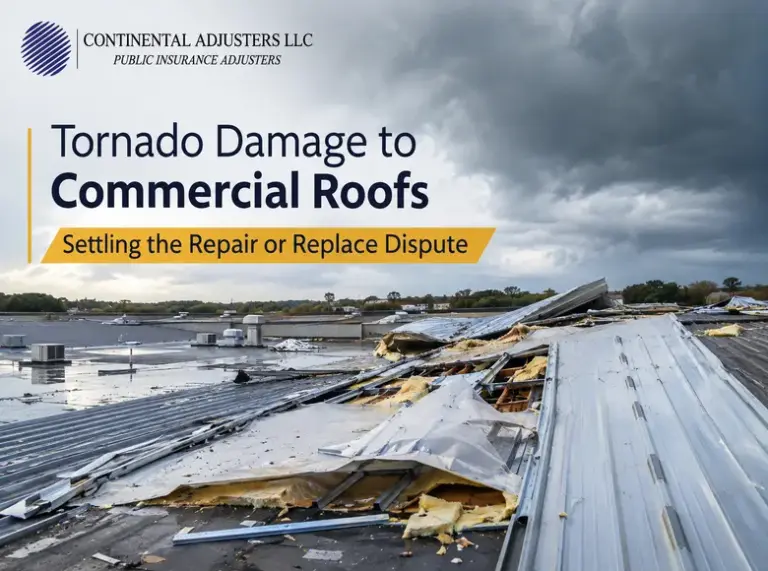
A repair or replace dispute is a disagreement between a building owner and the carrier over whether tornado damage to a commercial roof needs spot repairs or a full replacement. The carrier’s first estimate tends to price patches, seam work, and a handful of new panels. The owner sees a roof that leaks in new places after every rain and a membrane that no longer holds a patch. On a large warehouse or retail center, the gap between those two scopes is the largest number in the claim.
Owners in this position are right to question a repair-only number. The answer turns on facts the carrier’s estimate leaves out: what sits under the membrane, how worn the roof system is, and what local codes demand once work begins. This guide explains how carriers make the call, the roof items that decide it, and which buildings have the most at stake. It also covers what a public adjuster does on these claims, how a roof review works step by step, and what a full settlement is worth.
What Is a Public Adjuster, and Where Does One Fit in a Roof Dispute?
A public adjuster is a state-licensed professional who represents the policyholder in a property insurance claim. On a commercial roof claim, that work covers reading the policy, documenting the roof, writing the estimate, and negotiating the settlement. The carrier’s adjuster and engineer work for the insurance company, and the roofing contractor works under a repair contract. Each one sees part of the roof question, but only the public adjuster is hired to present the full claim for the owner.
Texas draws a firm line between these roles. Under Texas Insurance Code §4102.158, Texas public adjusters cannot take part in repairing or rebuilding property on a claim they adjust. Section 4102.163 bars a contractor, including a roofer, from acting as a public adjuster on a property it works on or may work on, as the Texas Department of Insurance explains. That separation keeps the person who negotiates the roof scope away from any profit on the roof job.
How Carriers Decide Between Repair and Replacement After Tornado Damage
A carrier’s roof decision starts with what its adjuster can see and measure on site. Torn membrane, missing panels, and debris punctures get priced as area repairs. The estimate then applies depreciation for roof age and pays actual cash value first, holding back the balance until work is complete, depending on the policy. Wet insulation, failed seams outside the torn area, and code requirements rarely make it into that first scope.
Repairability is the real test. A roof qualifies for repair only if new material bonds to the old and the repaired system performs as a whole. Aged single-ply membranes, saturated insulation boards, and metal panels no longer in production fail that test. The claim record needs to show which of those conditions apply, one roof section at a time.
| What the Repair Estimate Assumes | What a Replacement Record Shows |
| Damage is limited to torn or punctured areas | Uplift, seam separation, and loose fasteners across the roof field |
| Insulation under the membrane is dry | Core samples and moisture scans showing wet boards |
| New membrane will bond to the existing roof | Failed weld tests or a membrane too brittle to accept a patch |
| Replacement material will match the existing roof | Discontinued panels or membranes with a different profile or color |
| No code work is required | Local code triggers for insulation, edge securement, or drainage |
Roof Claim Items That Decide Repair or Replacement
Wet Roof Insulation
Water that enters through a tornado breach spreads under the membrane, and saturated boards cannot stay in place under a patch.
Membrane Repairability
Weld tests and test patches show whether new material can bond to an aged membrane, which decides if spot repair is possible at all.
Uplift Across the Roof Field
Wind uplift loosens fasteners and separates seams far from the torn area, so a scope counted only at visible tears understates the loss.
Matching and Discontinued Materials
Metal panels and membranes that are no longer made cannot blend into the existing roof, and some commercial policies address this, depending on the policy wording.
Code Upgrade Costs
Local codes can require added insulation, edge securement, or drainage changes on replaced areas, and ordinance or law coverage pays for that work, depending on the policy.
Rooftop Equipment and Flashing
A replacement means lifting or disconnecting HVAC units, resetting curbs, and installing new flashing, and each of those costs belongs in the scope.
Lost Income During Roof Work
A full tear-off can close floors, displace tenants, or slow production, and business income coverage can apply to that period, depending on the policy.
Which Commercial Properties Face the Largest Roof Disputes
Roof disputes grow with roof size and complexity. A modest patch-versus-replace gap on a small retail building becomes a major claim item on a distribution center covering several acres. Facility managers and owners of the properties below have the most riding on how the roof decision gets made.
- Warehouses and distribution centers with large single-ply or metal roofs, where uplift spreads across acres of roof field.
- Retail centers with roof sections installed in different years, where a section-by-section repair leaves a mismatched system.
- Office and medical buildings with dense rooftop equipment, where replacement means moving units and resetting curbs.
- Hotels and apartment communities, where roof work displaces guests or residents and adds income loss to the claim.
- Properties holding a repair-only estimate from the carrier while new leaks keep appearing.
How Continental Adjusters Builds the Case for a Full Roof Replacement
Commercial roof claims are settled on documentation, not opinion. The Office Park Tornado claim shows what a complete record can change. The firm was engaged about ten months after the loss and built a full record of the physical damage across the property. The insurer’s $6.7 million offer became an $11.5 million settlement.
1. The firm represents only the policyholder, never the insurance carrier, and has no stake in which roofing contractor gets the job.
2. In-house estimators price the replacement scope line by line in Xactimate, from tear-off and insulation to curbs, flashing, and code items.
3. The team handles claims with large commercial roof areas and multiple roof sections, on one property or across a portfolio.
4. Forensic accounting measures the income lost while roof work closes space or slows operations.
5. Appraisal and umpire services give owners a path when the carrier accepts coverage but disputes the amount.
How a Commercial Roof Claim Review Works
1. Read the carrier’s estimate against the policy. The review lists every roof item the carrier priced and every item it left out. The policy is then checked for replacement cost terms, depreciation holdback rules, matching language, and ordinance or law limits. This separates coverage questions from scope questions.
2. Test the roof, section by section. Roof consultants take core samples, run moisture scans, and perform weld tests or test patches on the existing membrane. Each test location is marked on a roof plan and photographed with the date. The results show where repair is possible and where it is not.
3. Identify code requirements. The local building department’s rules for replaced roof area are checked, including insulation values, edge securement, and drainage. Code-driven work gets its own estimate lines so it can be tied to ordinance or law coverage.
4. Write the replacement estimate. In-house estimators build the full scope in Xactimate, covering tear-off, disposal, insulation, membrane or panels, flashing, equipment resets, and code items. Income lost during the roof work is measured as a separate part of the claim.
5. Present, negotiate, and resolve. The estimate goes to the carrier with test results, photos, and the roof plan, so each item can be reviewed on its own. If the carrier agrees the roof is covered but disputes the amount, the policy’s appraisal clause offers a path to an independent figure.
What a Full Roof Settlement Is Worth Compared With a Repair Estimate
The value of a roof review shows up in the final scope. A repair estimate pays for patches on a roof that keeps failing, while a replacement settlement pays for a roof system that works as a whole. Add code upgrades, equipment resets, and lost income, and the difference between the two numbers grows fast. That difference is what the owner absorbs if the claim closes on a repair-only scope. On the Office Park Tornado claim above, a complete damage record was worth $4.8 million over the insurer’s offer.
Public adjuster fees are set by state law, and many states, including Texas, cap them. Under Texas Insurance Code §4102.104, Texas public adjusters can charge no more than 10% of the insurance settlement, including expenses. The limit stays the same on a $300,000 roof claim and a $5 million one. The firm works on a contingency fee set in a written contract, so the roof review carries no up-front cost.
Frequently Asked Questions About Tornado Roof Claims
When does tornado damage turn a commercial roof repair into a replacement?
Continental Adjusters treats tornado damage as a replacement claim once spot repairs can no longer restore the roof as a working system. Wet insulation, membrane that will not take a weld, widespread fastener pullout, and discontinued materials are the common tipping points. The team ties each finding to a marked roof section, so the carrier can see exactly where repair fails.
Why does wet insulation matter so much on a roof claim?
Continental Adjusters checks the insulation early, because saturated boards hold water against the deck and cannot stay under a new patch. Core samples and moisture scans locate the wet areas and measure how far they spread. Large wet areas push the scope toward replacement, and carrier estimates on flat commercial roofs commonly leave them out.
What is a public adjuster expected to do on a commercial roof claim?
Continental Adjusters’ licensed public adjusters read the policy, document the roof, write the estimate, and negotiate the settlement for the policyholder. On roof disputes, that means turning test results and code research into a scope the carrier can review line by line. The work continues through supplements and any appraisal.
Does ordinance or law coverage pay for roof code upgrades?
Continental Adjusters reviews the ordinance or law section on every roof replacement claim, since this coverage pays for work local codes require, such as added insulation or new edge securement, depending on the policy. Commercial policies commonly set a separate sublimit for it. Each code item gets its own estimate line so it can be paid.
How does depreciation affect a commercial roof settlement?
Continental Adjusters tracks the depreciation holdback from the first payment, because the carrier pays an aging roof’s actual cash value first. On replacement cost policies, the held-back amount becomes payable once the work is completed, depending on the policy terms and deadlines. Missing that deadline can leave the holdback unpaid.
Can Texas public adjusters use my roofing contractor’s inspection findings?
Continental Adjusters, like other Texas public adjusters, can use a contractor’s photos, measurements, and test results as part of the claim record. The firm’s in-house estimators still write the claim estimate, with the contractor’s findings as support. Texas law keeps the roles separate, so the contractor builds the roof and the public adjuster presents the claim.
What does a roof claim review cost the building owner?
Continental Adjusters charges a contingency fee set in a written contract, so the review and the estimate carry no up-front cost. The fee comes from the recovery, which keeps the work focused on getting every covered roof item paid.
What if testing shows the carrier’s repair scope is right?
Continental Adjusters tells the owner early when core samples and weld tests support the carrier’s repair scope, so the owner can decide whether to pursue the roof dispute further. The test results and roof plan still document the roof’s condition for any later claim.
The roofer already gave the carrier a repair price. Does that lock in the scope?
Continental Adjusters treats a contractor’s repair bid as one document in the claim, not the final scope. Carriers often adopt the first repair number before the roof is tested, and core samples or weld tests can still show that the same roof needs replacement. The estimate is then revised and resubmitted with the test results.
Will core samples and weld tests damage the roof or affect its warranty?
Continental Adjusters checks the roof warranty before testing starts, because some manufacturer warranties set conditions for cutting into the membrane. Core cuts are sealed as they are taken and logged on the roof plan, so test points do not become new leak paths.
New leaks keep appearing where the roof was patched. Does that change the claim?
Continental Adjusters treats leaks at patched areas as evidence that the repair scope did not restore the roof, which can support a supplemental claim, depending on the policy terms and state deadlines. Dated photos of each leak and moisture readings next to the patch tie the failure back to the original tornado loss.
The carrier’s engineer says the roof can be repaired. Can that finding be challenged?
Continental Adjusters answers an engineer’s repair finding with roof-specific evidence such as core samples, weld tests, and moisture scans. Carrier engineers tend to focus on visible tears and leave out wet insulation and seam failure across the roof field. If the dispute is over the dollar amount rather than coverage, the appraisal clause lets each side name an appraiser, with an umpire settling any gap.
Get the Roof Scope Right While the Claim Is Still Open
A repair-only estimate on a failing roof leaves the owner paying for the next leak. If tornado damage left your commercial roof with wet insulation, recurring leaks, or a scope that stops at patches, ask Continental Adjusters for a roof claim review. The team will test the roof, price the full scope, and show where the carrier’s estimate falls short.