

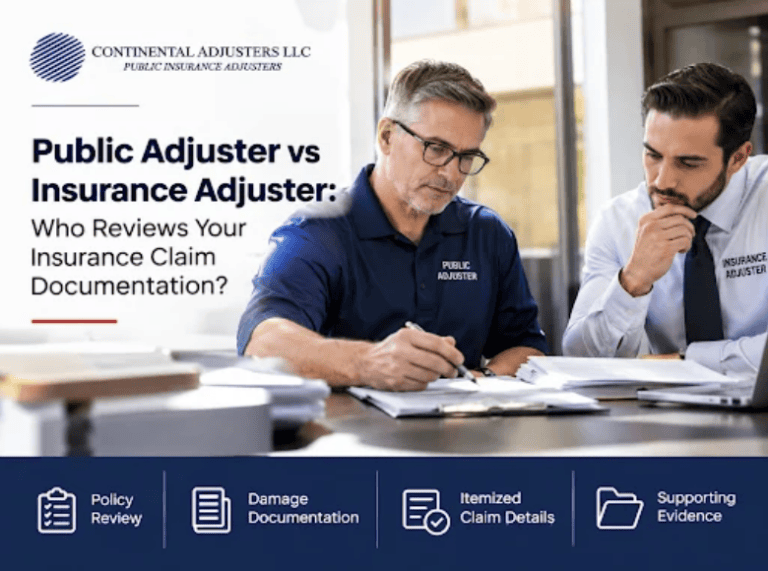
An insurance company adjuster reviews your claim documents for the insurer, while a public adjuster builds and reviews them for you. That split is the core of the public adjuster vs insurance adjuster comparison, and a search for insurance adjusters near me after a commercial loss turns up both kinds. Photos, invoices, repair estimates, and business records all pass through an adjuster’s hands, and the person reading them shapes what gets paid.
This guide explains what each adjuster looks for in your documentation, where gaps cost policyholders money, and how an independent review works. You will also find what the review costs and answers to the questions owners raise most. Each section stays focused on the claim file, because that file is what the carrier pays from.
What Does a Public Adjuster Do With Your Claim Documentation?
A public adjuster is a licensed professional who represents the policyholder in a property insurance claim. The insurer pays no part of the public adjuster’s fee, and the public adjuster owes no duty to the insurer. That independence changes how the claim file is built, because every photo, measurement, and invoice is gathered to show the full loss under the policy. The public adjuster also handles the back-and-forth with the carrier, so owners can return to running the business.
Commercial claims carry more paperwork than most owners expect. A single loss can involve the building, equipment, inventory, tenant improvements, lost business income, and extra expense. Each category needs its own proof, and a missing piece in one area can stall the entire claim. The public adjuster services page explains how this representation works from first inspection to final payment.
How the Insurance Company Adjuster Evaluates Your Claim File
The insurance adjuster reviews the claim for the insurance company, whether that person is a staff employee or an independent adjuster hired by the carrier. That adjuster inspects the damage, compares it to the policy language, and writes an estimate in software such as Xactimate using regional price lists. The goal is to confirm what the policy covers and what the carrier owes, seen from the carrier’s side. Damage that never makes it into the file rarely makes it into the payment.
Many states set deadlines for this document exchange, including Texas. Under Texas Insurance Code Chapter 542, most insurers must acknowledge a claim, begin the investigation, and request the items they need within 15 days of written notice. The insurer then has 15 business days after receiving every requested item to accept or reject the claim, and a rejection must state the reasons. If the insurer needs more time, it must say why in writing, and it then has up to 45 more days to decide. Because that clock starts only once the file is complete, a slow or partial document response pushes the decision back.
Public adjuster vs insurance adjuster: who reviews what
| Documentation Task | Insurance Company Adjuster | Public Adjuster |
| Works for | The insurance company | The policyholder only |
| Damage inspection | Confirms damage the carrier considers covered | Records all damage, including hidden areas |
| Repair estimate | Writes the carrier’s estimate | Writes an independent estimate line by line |
| Policy review | Applies limits, deductibles, and exclusions | Looks for every coverage that fits the loss |
| Business records | Requests records to test the loss | Organizes records to prove the full loss |
| Settlement offer | Recommends a figure to the carrier | Checks the offer against the documented loss |
Documentation Services Included in an Independent Claim Review
Damage Documentation
Adjusters inspect the property and record each damaged area in Encircle with photos, measurements, and written notes.
Independent Repair Estimates
Estimators price the repair scope line by line in Xactimate or Symbility, working from the inspection record instead of the carrier’s scope.
Policy and Coverage Review
The policy and its endorsements are read against the loss to find coverages the claim leaves out, such as business income or code upgrades, depending on the policy.
Forensic Accounting for Business Income
The forensic accounting service ties lost revenue and extra expense to the financial records a carrier will test.
Carrier Negotiation
The team answers each document request from the carrier’s adjuster and negotiates the scope and price of the claim.
Appraisal and Umpire Support
When both sides agree on coverage but not on the amount, appraisal and umpire services give the claim a formal path to resolution.
Who Needs an Independent Review of Claim Documentation?
The public adjuster vs insurance adjuster question matters most when the loss is large, the paperwork is heavy, or the numbers do not match. An independent review fits these situations:
- Commercial property owners with damage across several buildings or units
- Business owners whose operations stopped or slowed after the loss
- Property managers and landlords tracking tenant improvements and lost rents
- Manufacturers and warehouse operators with damaged equipment and inventory
- Owners whose carrier estimate came in far below a contractor’s bid
- Policyholders who received a partial denial and need the reasons tested
Search results for insurance adjusters near me mix carrier-side firms with public adjusters, so ask each one who it works for, how it documents a loss, and who will walk the property. A claim file built at the site holds up better than one assembled from photos alone. Continental Adjusters sends its adjusters to inspect the property in person and builds the claim record from that visit.
Why Commercial Policyholders Choose Continental Adjusters for Claim Documentation
- The firm represents only the policyholder, never the insurance carrier, so every document in the file is gathered to support your claim.
- A second reviewer checks every estimate prior to submission, so pricing errors are caught on your side first.
- A claim manager compares each settlement offer with the full claim record, and only then is the client asked to accept it.
- Building, contents, and business income documentation are handled together, so the carrier receives one complete claim instead of scattered pieces.
- The firm has collected over $4 billion in settlements for policyholders in more than 40 states.
How the Independent Documentation Review Works
- Claim intake. You share the policy, the carrier’s letters, and any estimate or offer received so far. The team lists the documents the carrier has requested and flags any coverage the current claim leaves out.
- Site inspection. Adjusters walk the property with the owner or property manager and tie photos and measurements to each damaged area. This record answers the questions the carrier’s adjuster will raise and captures damage the first inspection missed.
- Estimate and gap comparison. The independent estimate is compared with the carrier’s estimate line by line. Every missing item, quantity difference, and pricing gap is listed, so the carrier can see exactly where the totals split.
- Claim package and negotiation. The estimate, photos, and supporting records go to the carrier as one organized package. Continental Adjusters then handles the discussions with the carrier’s adjuster and answers each follow-up request.
- Settlement and collection. You review the final offer with your claim manager and decide whether to accept. If the two sides still disagree on the amount, the policy’s appraisal clause offers a path forward.
Documentation can change a claim well into the process. On an office park tornado claim, Continental Adjusters came in about ten months after the loss, when the carrier’s figure stood at $6.7 million. The team documented the physical damage in full, and the claim settled for $11.5 million, a 72% increase over the initial offer. The case studies page shows more results from commercial losses.
What Does a Public Adjuster Cost Compared With the Value of Better Documentation?
A stronger claim file is where the value of a public adjuster shows up. When documentation captures hidden damage, missed coverages, and current repair pricing, the settlement reflects the actual loss instead of the carrier’s first estimate. Of the insurance adjusters near me who might handle a claim, the carrier’s adjuster costs you nothing directly, but that adjuster’s estimate is the carrier’s number, not yours.
Public adjuster fees are set in a written contract, and many states cap them, including Texas. Texas Insurance Code §4102.104 limits a public adjuster’s compensation to 10% of the insurance settlement, and 28 TAC §19.708 requires the contract to state that the cap includes expenses and direct costs. Continental Adjusters works on a contingency basis, so its fee depends on what the claim recovers.
The practical test is a side-by-side comparison of the carrier’s current offer and a fully documented estimate. If the gap is small, the review confirms the offer is fair and the owner can settle with confidence. If the gap is large, the review shows exactly where the money sits and what proof it will take to recover it.
Public Adjuster vs Insurance Adjuster: Claim Documentation FAQs
What does an insurance company adjuster check first in a commercial claim file?
Continental Adjusters sees carrier adjusters start with the cause of loss, the policy period, and whether the damage falls under a covered peril. Scope, repair pricing, and business income records come next. Its claim intake follows that same order, so the first documents sent to the carrier answer those questions directly.
Why do two adjusters reach different numbers from the same damage?
Continental Adjusters finds that most gaps start with scope, because one estimate includes items the other leaves out. Labor rates, price list dates, and code upgrade costs widen the difference. Hidden damage found at reinspection, such as wet insulation behind finished walls, adds more.
When I call insurance adjusters near me, what should the first meeting cover?
Continental Adjusters asks for the full policy with endorsements, every letter from the carrier, and any estimate, photos, or offer already received. For business income claims, it also asks for recent profit and loss statements. Those items show what the carrier has seen and what the claim file is missing.
Can I get copies of the insurance adjuster’s photos and estimate?
Continental Adjusters requests the carrier’s photos, estimate, and any engineer or consultant reports early in each claim. Those documents show what the carrier’s adjuster saw and what was left out. Placing them beside an independent inspection is the fastest way to find the gaps.
How long should damaged materials and records be kept after a loss?
Continental Adjusters advises keeping damaged materials, equipment, and receipts until both sides have photographed, measured, and documented them. Commercial property policies list letting the insurer inspect damaged property among the insured’s duties after a loss. Its adjusters log each item in Encircle, so nothing leaves the site without a record.
Does a documentation review cover business income records as well as building damage?
Continental Adjusters reviews both, because a commercial loss rarely stops at the building. Its forensic accounting service measures lost income and extra expense using tax returns, sales history, and payroll data. Those figures sit in the same claim package as the repair estimate.
Who pays the insurance adjuster, and who pays a public adjuster?
Continental Adjusters is paid by the policyholder through a contingency percentage written into the contract, with nothing billed upfront or by the hour. The carrier’s staff or independent adjuster is paid by the insurer, so that adjuster’s estimate reflects the carrier’s view of the loss. Neither arrangement changes what the policy covers, only who checks the file on the owner’s behalf.
What happens if the review shows the carrier’s numbers were right?
Continental Adjusters tells the owner plainly when the carrier’s estimate holds up. If nothing is recovered, there is no fee. The owner still comes away knowing the settlement was checked against a full inspection.
Will my insurer stop talking to me once a public adjuster is on the claim?
Continental Adjusters works for the owner, and the owner keeps every right to speak with the carrier. Most owners still route documents through the adjuster so the claim file stays consistent. One channel for records keeps two versions of the same invoice or estimate from reaching the carrier.
My last adjuster lost track of my paperwork. What is different here?
Continental Adjusters records each claim in Encircle, so photos, notes, and documents stay tied to the area they describe. Every claim also has a dedicated estimator, which keeps pricing questions with one person. That structure keeps records from scattering across email threads and contractors.
The carrier says it already has everything it needs. Is it too late to add documentation?
Continental Adjusters checks the policy deadlines and the claim status first, because those dates decide what can still be submitted. A carrier’s statement that its file is complete does not close the claim on its own. If the claim is open, supplemental documentation can still change the result.
Will bringing in a public adjuster turn my claim into a fight with the insurer?
Continental Adjusters treats most claims as a documentation exercise, not a dispute. Carrier adjusters work with public adjusters every day, and an organized file gives them what they need to move the claim forward. Appraisal, alternate dispute resolution, or property damage attorneys come in only when the two sides cannot agree.
Have Your Claim File Reviewed by the Side That Works for You
If the carrier’s adjuster has already reviewed your documents, the next question is whether anyone has reviewed them for you. Of all the insurance adjusters near me who touch a claim, only a public adjuster reviews the file for you, and the difference shows up in what the file includes and what it leaves out. Continental Adjusters can compare your claim file with the damage and the policy and show you where the gaps are. Contact the team to talk through your claim.