

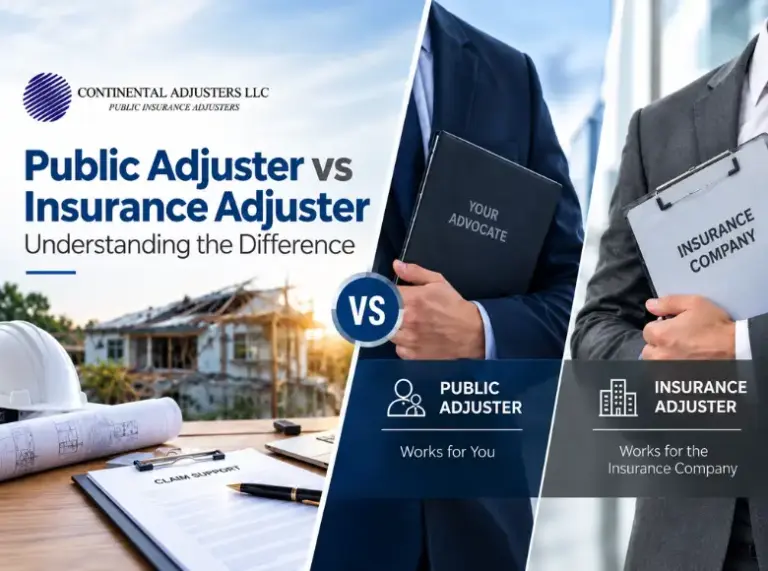
A public adjuster is a licensed claims professional hired by the policyholder, while an insurance adjuster evaluates the loss on behalf of the insurance company. Both inspect the same damaged building, read the same policy, and estimate the same repairs. The difference is who they represent and whose financial interest shapes the final number. For a commercial property owner facing a six or seven figure loss, that difference decides how much of the recovery reaches the business.
After a hurricane, fire, or burst pipe shuts down a hotel, warehouse, or office building, the first adjuster to arrive is the one the carrier sends. Owners assume that person is there to make them whole, and that assumption is easy to understand. This guide answers the public adjuster vs insurance adjuster question in plain terms. You will see what each role does, which services support a disputed claim, who benefits most from independent representation, and how Continental Adjusters handles commercial losses from first inspection to final payment.
Public Adjuster vs Insurance Adjuster: Who Each One Represents
An insurance adjuster works for the carrier, either as a staff employee or as an independent adjuster the carrier hires for the claim. That adjuster inspects the damage, applies the policy language, and recommends what the carrier should pay. A public adjuster works only for the policyholder and handles the same tasks from the opposite side of the table. The public adjuster documents the full scope of loss, prices it, presents it to the carrier, and negotiates the settlement.
The U.S. Bureau of Labor Statistics describes this split in plain terms. According to the BLS Occupational Outlook Handbook, adjusters who work for insurance companies aim to save the company as much money as possible, while a public adjuster working for a claimant aims to get the highest possible payment. Neither role is dishonest, but each one answers to a different client. The table below shows how that plays out on a commercial claim.
| Factor | Insurance Adjuster | Public Adjuster |
|---|---|---|
| Who hires them | The insurance carrier | The policyholder |
| Whose interest they protect | The carrier | The business or property owner |
| How they are paid | Salary or a fee from the carrier | A percentage of the settlement |
| Scope of loss review | Items the carrier accepts as covered | Every item the policy supports, including business income |
| Role in a dispute | Defends the carrier’s position | Builds and argues the owner’s claim |
Commercial claims widen this gap. A retail center or manufacturing plant loss can include building damage, equipment, inventory, code upgrades, tenant issues, and lost business income. An adjuster managing dozens of files after a storm has limited time to chase every line item. Items left out of the first estimate rarely get added unless someone on the owner’s side pushes for them.
Services That Support a Public Adjuster for Insurance Claims
Public adjusters rarely work alone on large commercial losses. Continental Adjusters brings four services under one roof, so a disputed claim does not stall while the owner searches for outside experts. Each service answers a different part of the recovery.
Public Adjuster
A public adjuster from Continental Adjusters inspects, documents, prices, and negotiates the full commercial property loss on behalf of the policyholder.
Forensic Accounting
Forensic accounting measures business income loss and extra expense with financial records that hold up to carrier review, which matters when a hotel or plant stays closed for months.
Expert Witness
Expert witness services give courts, mediators, and appraisal panels credible testimony on claim handling, damage scope, and valuation when a claim moves toward litigation.
Umpire and Appraisals
Umpire and appraisal services resolve disagreements over the amount of loss through the appraisal clause, a process built to break a deadlock without a lawsuit.
Which Commercial Property Owners Benefit Most From Independent Representation
Independent representation pays off most when the loss is large, complex, or already in dispute. Owners of apartment communities, hotels, warehouses, healthcare facilities, schools, shopping centers, and office parks face claims with many moving parts. A single event can damage the building, stop operations, displace tenants, and trigger code upgrade costs at the same time. Those layers are where early estimates fall short.
Timing signals matter too. A business should consider a public adjuster for insurance claims when the carrier’s offer arrives well below repair bids, when a denial letter cites unclear exclusions, or when business income losses keep growing without a clear payment path. Property managers and risk managers who oversee several locations also gain from having one point of contact for every claim. Bringing in help after an offer arrives is still an option, as long as the owner has not accepted a final settlement and the policy deadlines have not passed.
How Continental Adjusters Helps Commercial Policyholders
Why Commercial Owners Choose Continental Adjusters
- Commercial and institutional focus. Continental Adjusters concentrates on commercial and institutional property claims. The team understands multi-building portfolios, tenant leases, and business income worksheets. That focus shapes every estimate and every negotiation.
- A proven settlement record. Continental Adjusters has collected over $4 billion in settlements for its clients. That record spans hurricanes, tornadoes, hail, freezes, and water losses. Each claim file is built to withstand appraisal or court review.
- Specialists under one roof. Public adjusting, forensic accounting, expert witness, and umpire and appraisal services work together inside one firm. Owners avoid the delay of hiring separate consultants when a dispute escalates. The same team that documented the loss supports it through every stage.
- Nationwide and international reach. Continental Adjusters serves clients nationwide and internationally from its McKinney, Texas headquarters. Past clients include school districts, resorts, apartment operators, and court-appointed property receivers. That range brings practical experience to unusual and high-value losses.
How the Claim Process Works
- Policy and loss review. Continental Adjusters reads the full policy, endorsements, and any carrier correspondence. The team identifies every coverage part that applies, from building and contents to business income and code upgrades. This review sets the scope for the entire claim.
- Inspection and documentation. Adjusters and building specialists inspect the property and record damage with photos, measurements, and written notes. Hidden damage, such as moisture behind walls or roof deck failure, gets tested and recorded. Clear documentation prevents later arguments over what the event caused.
- Estimating and loss valuation. The team prices repairs line by line using current material and labor costs. Forensic accountants calculate lost income and extra expense from the business’s financial records. Together, those figures form a complete claim package.
- Presentation and negotiation. Continental Adjusters submits the claim package and meets with the carrier’s adjuster and consultants. Each disputed item is supported with evidence and policy language. Negotiation continues until the numbers reflect the documented loss.
- Appraisal, litigation support, and payment. When negotiation stalls, the appraisal clause or expert witness support moves the dispute toward resolution. Continental Adjusters stays involved until the carrier issues payment. The owner receives a clear record of what was claimed, what was paid, and why.
Case Study: Hurricane Laura Shopping Center Claim
Hurricane Laura caused wind damage across multiple shopping center locations owned by one insured. The initial offer from the insurer came to $40 million. The insured contacted Continental Adjusters to represent the claim, which covered 362,000 square feet of retail property. Continental Adjusters negotiated a settlement of $64 million, an increase of 60 percent over the first offer.
This case shows the gap described earlier in this guide. The carrier’s figure reflected its own review of the loss, while independent representation put the policyholder’s position in front of the carrier. On a multi-location retail claim, that 60 percent difference equaled $24 million that stayed with the business. Owners can review this result and others on the Continental Adjusters case studies page.
What Independent Representation Costs and What It Returns
A public adjuster charges a contingency fee, which means the fee is a percentage of the settlement rather than an upfront bill. State law sets the limits on that fee. The Texas Department of Insurance states that a public insurance adjuster’s fee may not exceed 10 percent of a claim settlement and must be disclosed in the written contract. Other states set their own caps and contract rules, so owners should read the fee terms before signing.
The fee makes sense when it is compared with the increase it produces. As a simple illustration, a 10 percent fee applied to the $64 million Hurricane Laura settlement would still leave $57.6 million, which is $17.6 million above the carrier’s first offer. A small, undisputed claim with clear coverage is a different story, and an experienced adjuster will say so up front.
Frequently Asked Questions About Public Adjusters
1. What does an insurance adjuster do on a commercial claim?
An insurance adjuster inspects the damaged property, reviews the policy, and recommends a payment amount to the carrier. The adjuster represents the insurance company throughout the claim. On a commercial loss, that review covers the building, contents, and any business income the carrier accepts.
2. What does a public adjuster do for a business?
A public adjuster represents the business owner from the first inspection to the final payment. The work includes policy review, damage documentation, repair pricing, business income analysis, and settlement negotiation. Continental Adjusters handles each of these steps for commercial and institutional properties.
3. Are independent adjusters the same as public adjusters?
An independent adjuster is a contractor the insurance company hires to handle claims, so that adjuster still works for the carrier. A public adjuster is licensed to represent only the policyholder. The word “independent” describes employment status, not whose side the adjuster takes.
4. How does the appraisal clause work in a commercial property claim?
The appraisal clause lets each side choose an appraiser when the owner and carrier disagree on the amount of loss. The two appraisers try to agree, and an umpire decides any items they cannot resolve. Continental Adjusters provides umpire and appraisal services for commercial disputes.
5. When does a commercial claim need forensic accounting?
Forensic accounting becomes necessary when a loss stops or slows operations and the business income claim is large. Forensic accountants rebuild lost revenue and extra expense from tax returns, sales records, and payroll data. That analysis gives the carrier a documented figure instead of an estimate it can easily discount.
6. What does an expert witness add to an insurance dispute?
An expert witness explains technical claim issues, such as the cause of damage or the value of a loss, to a judge, jury, or mediator. The testimony carries weight because it comes from direct claims experience. Continental Adjusters offers expert witness services when a commercial claim moves into litigation.
7. How much does a public adjuster cost?
A public adjuster fee is a percentage of the settlement, paid from the recovery rather than upfront. State insurance laws set caps and contract requirements for that percentage. Continental Adjusters reviews its fee terms with each client in a written contract before any work begins.
8. Will hiring a public adjuster hurt my relationship with my insurance company?
Hiring a licensed public adjuster is a legal right of the policyholder, and it does not cancel the claim or the policy. The carrier must still handle the claim under the policy terms and state claim handling rules. Continental Adjusters works directly with the carrier’s adjuster in a professional manner throughout the process.
9. Why not rely on the insurance company’s adjuster?
The insurance company’s adjuster follows carrier guidelines and reports to the carrier, even when that adjuster is courteous and fair. Commercial losses include items a carrier’s review can miss, such as code upgrade costs, hidden damage, and extended business income. A public adjuster for insurance claims makes sure each of those items is documented and presented.
10. Is it too late to hire a public adjuster after the carrier makes an offer?
A carrier’s offer is a starting point until the owner accepts it and signs a release. Continental Adjusters took on an office park tornado claim ten months after the loss and still negotiated a higher settlement. Owners should check the policy’s deadlines for disputing the amount before waiting any longer.
11. Will a public adjuster slow down my claim?
A public adjuster keeps a commercial claim moving by delivering complete documentation early. Complete files reduce the rounds of information requests that stall large claims. Continental Adjusters also manages carrier communication, so owners and facility managers can stay focused on operations.
12. Does my business need a public adjuster for a small claim?
A small, undisputed claim with clear coverage rarely needs outside representation. Public adjusting delivers the most value on large, complex, or disputed commercial losses where the gap between the offer and the true loss is significant. Continental Adjusters can review a loss with the owner to decide whether representation makes financial sense.
Talk With Continental Adjusters About Your Commercial Claim
The choice between relying on the carrier’s adjuster and hiring independent help comes down to representation. The carrier’s adjuster protects the carrier’s position, and a public adjuster protects yours. For hotels, warehouses, apartment communities, schools, and retail centers, that difference can reach millions of dollars on a single loss.
If your business is weighing an offer that feels low, facing a denial, or struggling to measure lost income, a second opinion gives you options. Continental Adjusters reviews commercial claims nationwide and explains each path in plain terms before you commit to anything. Contact Continental Adjusters to discuss your loss and choose the next step with full information.