

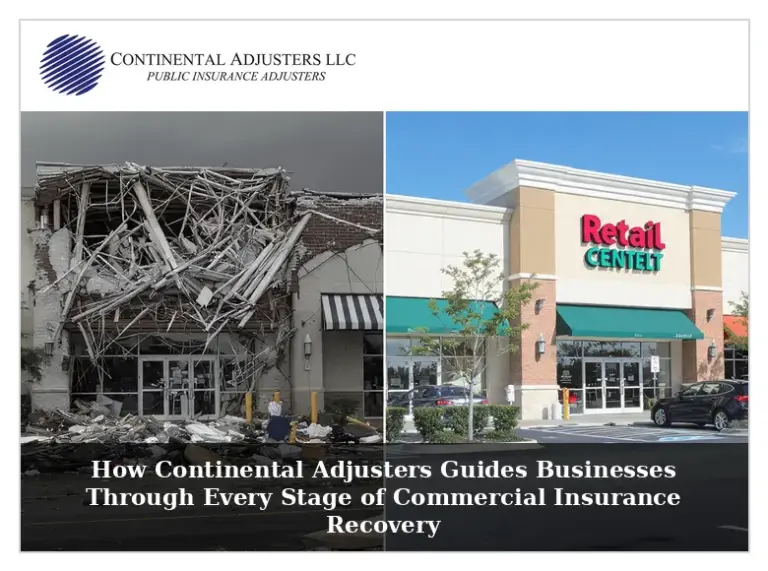
Commercial insurance recovery is rarely a simple process, and most owners find that filing a claim is an extremely complicated process. This article breaks down each stage of recovery and shows how Continental Adjusters helps business owners move through the process with clarity and confidence.
Why Commercial Insurance Recovery Is More Complicated Than Most Owners Expect
Insurance policies are written to protect the carrier’s financial position first. Business owners rarely read every clause, exclusion, and condition until a loss forces them to. By that point, the claim clock is already running.
Commercial insurance recovery services exist because the claims process involves more than submitting photos and waiting for a check. A commercial loss touches:
- Building structure and systems
- Equipment and inventory
- Business income and revenue
- Extra expenses tied to staying operational
- Tenant and lease obligations
Each category requires separate documentation, and each one can be challenged, delayed, or undervalued by the carrier’s adjuster.
The Real Stages of a Commercial Property Claim
A commercial claim moves through distinct phases. Skipping steps or rushing through them is where most owners lose money.
1. Loss Assessment and Documentation
Before any settlement discussion begins, the damage has to be measured accurately. This includes structural damage, equipment failure, contents loss, and any code upgrades required by local building authorities.
Insurance claim recovery for businesses starts here because incomplete documentation almost guarantees a lower payout. Continental Adjusters builds a complete damage inventory, supported by photos, estimates, and expert evaluations, so nothing gets left out of the claim.
2. Business Interruption Calculation
Physical damage is only part of the story. Lost revenue, idle payroll, and ongoing fixed costs add up fast during a shutdown. Business interruption coverage is meant to replace that lost income, but calculating it correctly takes financial analysis, not guesswork.
Forensic accounting is used to reconstruct what the business would have earned if the loss had not happened, then compares that figure to actual performance during the interruption period.
3. Claim Valuation and Negotiation
Once damages and losses are documented, the claim moves into valuation. Carriers frequently propose a settlement that reflects their own estimate, not an independent one. This is where disputes usually begin.
Continental Adjusters is a commercial public adjusting firm, which means it represents the policyholder exclusively, not the carrier. Their role is making sure the settlement reflects the actual cost of recovery rather than a reduced offer.
4. Appraisal, Umpire Proceedings, or Litigation Support
If negotiations stall, some policies allow for appraisal or umpire proceedings as a faster alternative to a lawsuit. Expert witness support may also be needed if a claim moves toward litigation. Having documentation and financial analysis prepared in advance strengthens the business owner’s position at every one of these stages.
Commercial Insurance Claim Assistance: What Business Owners Actually Need
Business owners rarely need a general explanation of their policy. They need specific answers:
- Is this damage fully covered?
- Is the carrier’s estimate accurate?
- How is lost income calculated?
- What documentation is missing?
- Is the settlement offer fair?
Commercial insurance claim assistance from Continental Adjusters focuses on answering these questions with evidence, not assumptions. That includes organizing documentation, preparing valuations, and communicating directly with the carrier on the policyholder’s behalf.
Natural Disaster Claims Bring Their Own Challenges
Natural disaster insurance claims for businesses carry added pressure because entire regions file claims at once. Carriers face a flood of submissions, adjusters are stretched thin, and settlement timelines slow down.
The stakes behind a slow or undervalued claim are significant. According to data frequently cited from the Federal Emergency Management Agency, 40 percent of small businesses never reopen after a disaster, and another 25 percent close within a year even after reopening (source: Insurance Information Institute). A claim that drags on or settles for less than it should adds directly to that risk.
The scale of these events has grown as well. Twenty-three separate weather and climate disasters caused at least a billion dollars in damage across the United States in 2025, with severe storms setting a new record for the year (source: Climate Central). Commercial property owners in storm-prone regions face a real chance of having to deal with a major claim.
| Disaster Type | Common Claim Complications |
| Hurricanes | Wind vs. flood coverage disputes, extended business closures |
| Flooding | Separate flood policy requirements, contents and inventory loss |
| Wildfires | Total loss valuation, delayed access to damaged sites |
| Severe Storms | Roof and structural disputes, secondary water damage |
| Winter Storms | Frozen pipe damage, equipment failure claims |
Commercial Insurance Claim Support for Disaster-Damaged Businesses
Recovering from a large-scale disaster takes more than paperwork. It takes coordination between contractors, accountants, and adjusters, all working from the same set of facts.
Commercial insurance claim support for disaster-damaged businesses from Continental Adjusters includes:
- Full damage documentation
- Forensic accounting for business interruption losses
- Expert witness preparation when disputes arise
- Appraisal and umpire representation
- Ongoing communication with the carrier
Without this coordination, a disaster claim often moves through separate channels that do not communicate with each other. A contractor’s repair estimate can sit disconnected from the accountant’s income calculation, and a carrier may settle the physical damage while leaving the income loss unresolved or underpaid. Bringing documentation, valuation, and financial analysis together under one process closes that gap.
This coordinated approach reduces back-and-forth delays and keeps the business owner informed at each stage.
Frequently Asked Questions
How long does commercial insurance recovery usually take?
Timelines vary based on damage severity and carrier response. Straightforward claims may resolve in a few months, while large or disputed losses can take over a year.
Does Continental Adjusters work with insurance carriers?
No. Continental Adjusters represents policyholders exclusively and does not work on behalf of insurance carriers.
What is business interruption coverage?
It replaces income lost while a business cannot operate normally due to a covered loss, including ongoing fixed costs during the closure.
When is forensic accounting necessary in a claim?
Forensic accounting becomes necessary when income loss, extra expenses, or financial damages need independent calculation to support a fair settlement.
What happens if a carrier’s settlement offer seems too low?
The policy owner can request appraisal, bring in expert witnesses, or negotiate further using independent documentation before considering litigation.
Can a business file a claim for both property damage and lost income?
Yes, most commercial policies allow separate claims for physical damage and business interruption, provided both are properly documented.
Moving Forward with Recovery
Commercial insurance recovery works best when it is treated as a structured process rather than a single event. Documentation, valuation, and negotiation each play an important role, and missing any one step can reduce what a business ultimately recovers.
Continental Adjusters works alongside business owners through every stage of this process, from the first damage assessment to final settlement. If your business is facing a commercial property claim, a conversation with our team can help clarify what recovery actually looks like for your situation.
Ready to talk about your claim? Contact Continental Adjusters to discuss your commercial property loss and find out what a fully documented recovery strategy could mean for your business.